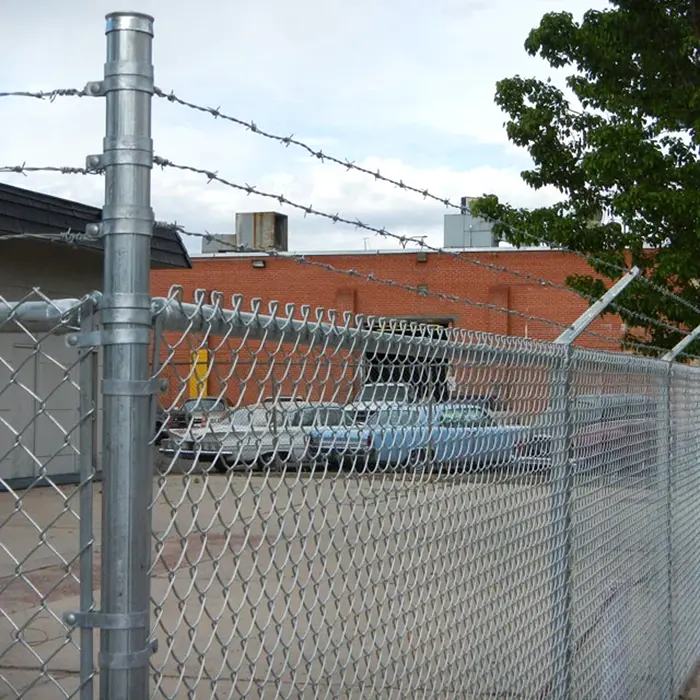

Razor barbed wire is widely used, mainly to prevent criminals from climbing or climbing over walls and fence climbing facilities, so as to protect property and personal safety.Generally it can be used in various buildings, walls, fences and other places.
The manufacturing of modern security barriers has evolved from simple blacksmithing to a highly sophisticated industrial process. At the heart of this evolution is the production of razor barbed wire, a product designed specifically to address the limitations of traditional fencing. Unlike standard fencing materials intended for livestock, these high-security components are engineered with a singular focus on anti-climbing and anti-intrusion capabilities. For a professional galvanized barbed wire manufacturer, the production cycle involves a meticulous combination of metallurgical science, precision stamping, and rigorous tension testing to ensure that the final product can withstand both environmental degradation and deliberate physical assault.
Metallurgical Foundations and the Role of the Galvanized Barbed Wire Manufacturer
The journey of a high-security fence begins long before the first barb is formed. It starts with the selection of raw materials, primarily high-tensile steel wire and cold-rolled steel coils. A reputable galvanized barbed wire manufacturer must prioritize the chemical composition of these metals to balance flexibility with brittle strength.
The galvanization process itself is a critical stage of production. Steel is prone to oxidation, especially when deployed in coastal or high-humidity environments. To combat this, the base wire undergoes a hot-dip galvanizing process where it is submerged in molten zinc. This creates a metallurgical bond that protects the steel from rust for decades. Manufacturers often categorize their output based on the thickness of this zinc coating, measured in grams per square meter. For industrial-grade security, a heavy galvanized coating is essential to ensure that the barbs remain sharp and the core wire remains impossible to snap, even after years of exposure to acid rain and extreme temperature fluctuations.
Once the wire is galvanized, it is tested for tensile strength. High-security applications require wire that can resist cutting by standard hand tools. This means the steel must have a high carbon content, making it "springy" and difficult to manipulate. If the wire is too soft, it can be easily bent or cut; if it is too brittle, it may snap under the tension of installation. Finding the perfect equilibrium is what separates a tier-one manufacturer from generic suppliers.
Precision Engineering: The Transformation into Razor Barbed Wire
The transition from a simple strand of steel to a formidable razor barbed wire involves a complex stamping and reinforcement process. Unlike traditional barbed wire, which consists of two wires twisted together with pointed wire barbs inserted between them, razor wire utilizes a sharp, punched steel tape that is mechanically crimped onto a high-tensile core.
The production line begins with a "punching machine" that takes a flat strip of galvanized or stainless steel. This machine uses precision dies to cut out the "razor" profile—typically consisting of long, needle-sharp blades spaced at regular intervals. The shape of these blades is not accidental; they are designed to snag clothing and penetrate skin with minimal pressure, creating a psychological and physical deterrent that is far superior to old-fashioned wire spikes.
After the tape is punched, it is fed into a "crimping machine." Here, the razor-sharp tape is wrapped tightly around the central high-tensile core wire. This is the most crucial step in ensuring the longevity of the product. If the crimping is loose, the razor tape can slide along the wire or be stripped off by an intruder. A high-quality razor barbed wire features a "perfect wrap," where the tape is essentially fused to the core, making it a single, inseparable unit. This structural integrity is what allows the wire to be stretched under high tension without losing its defensive shape.
Structural Innovations: The Rise of Welded Razor Wire Panels
While traditional coils are effective for top-of-fence security, the industry has seen a significant shift toward welded razor wire as a primary fencing material. This product represents a marriage between traditional mesh fencing and the lethal attributes of razor tape. Instead of being wound into a circular concertina shape, the razor wire is laid out in a grid pattern and welded at every intersection.
The production of welded razor wire requires specialized resistance welding equipment. Because the wire is under tension and the razor tape is sharp, the welding must be instantaneous and incredibly strong to prevent the mesh from deforming. The resulting panels feature a diamond or square pattern that is visually intimidating and physically impenetrable. The "anti-climb" nature of this design stems from the fact that the gaps in the mesh are too small to provide a foothold for a boot, yet the sharp blades ensure that anyone attempting to grip the fence with their hands will sustain immediate injury.
These panels are often used in high-stakes environments such as border crossings, military bases, and correctional facilities. Unlike a standard fence that might be bypassed with a simple ladder, a welded razor wire perimeter is a 3D obstacle. Even if a ladder is used, the sharpness of the mesh makes it nearly impossible to transition over the top without specialized shielding. Furthermore, the sheer density of the blades makes it extremely difficult to cut through the fence quickly, as an intruder would have to make dozens of individual cuts through high-tensile steel while navigating the surrounding blades.
Barbed Wire Fencing: Strategic Integration and Site-Specific Defense
The final stage of the production process is not occurring in the factory, but rather in the strategic planning of the installation. Professional barbed wire fencing supplies must be selected based on the specific risk profile of the site. A warehouse in an urban center may only require a single row of razor wire on top of an existing gate, whereas a remote power station might require a multi-layered system including a ground-level welded mesh and multiple overhead concertina coils.
When deploying these materials, installers must account for the "extension" of the wire. In the factory, razor wire is often clipped together at specific intervals to create the "Concertina" effect—a bellows-like expansion that forms a tubular barrier. The number of clips used per coil determines the density of the barrier. A higher number of clips results in a tighter, more difficult-to-breach coil, which is the standard for high-security zones.
Ultimately, the production of these materials is a testament to the ongoing arms race between security technology and those who seek to bypass it. From the initial smelting of the steel at the galvanized barbed wire manufacturer to the final welding of an anti-climb panel, every step is calculated to provide a few more seconds of delay. In the world of high-security, those seconds are the difference between a successful defense and a catastrophic breach.