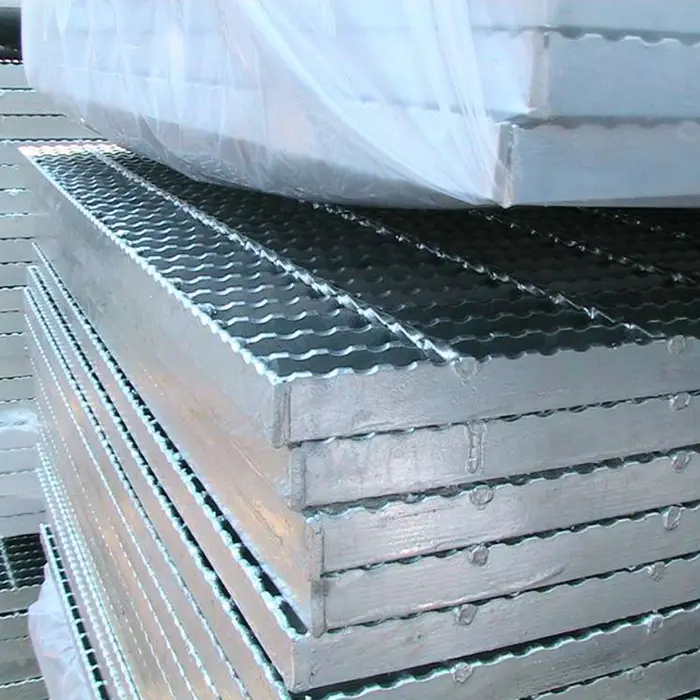

The serrated anti-skid galvanized steel grating is a measure taken to better improve the anti-skid ability of the steel grating surface. The serrated anti-slip galvanized steel grating is welded by serrated flat steel on one side and has strong anti-slip ability. It is especially suitable for wet and slippery places, oily working environments, stair treads, etc. It adopts thermal Galvanized surface treatment, strong rust resistance, maintenance-free and replacement-free for 30 years.
In the complex, demanding, and often hazardous environments of modern industry, safety is not merely a priority—it is a mandatory foundation for all operations. Walkways, access platforms, staircases, and maintenance areas must consistently provide a secure footing, especially when exposed to challenging elements such as water, oils, lubricants, or fine industrial dust. The most reliable and enduring solution adopted globally to meet this critical need is the use of specialized anti-slip steel grating.
Understanding the Anti Slip Plate Advantage: The Serrated Grating Design
The fundamental feature that elevates this type of flooring above conventional options is its vastly superior anti-slip capability. This is achieved through a meticulous design process: the load-bearing bars are constructed with a serrated flat steel profile that is subsequently welded to the cross bars. Unlike standard steel grating, which presents a smooth surface, the serrations introduce a multitude of sharp, high-friction contact points. This aggressive texture dramatically increases the coefficient of friction and grip, acting like tiny teeth that cut through surface contaminants to securely hold a worker’s boot, thereby preventing devastating slips and falls.
The surface of this grating functions as a highly effective anti slip plate alternative. By replacing solid flooring with an open mesh, facility managers gain the benefits of lighter weight, superior light penetration below the platform, and excellent ventilation and drainage, all while maintaining a high level of underfoot safety.
Integrating Serrated Bar Grating Dimensions with Safety Performance
The efficacy of the grating is heavily dependent on its structural specifications, encapsulated by the serrated bar grating dimensions. These dimensions are not arbitrary; they are precisely engineered to serve multiple functions simultaneously:
Bearing Bar Spacing and Thickness: Dictates the grating's ultimate load-bearing capacity and rigidity, ensuring it can safely support personnel, equipment, and dynamic loads.
Cross Bar Spacing: Affects stability and lateral load distribution.
Serration Profile: The height and pitch of the serrations are optimized to maximize traction without compromising structural integrity or making cleaning difficult.
This careful engineering ensures that the grating is robust enough to handle the stresses of heavy industrial traffic while maintaining maximum anti-skid surface area and facilitating effective drainage. The balance achieved is crucial: strength, load capacity, ventilation, and, most importantly, human safety are all harmoniously integrated into the final product.
Key Applications of Anti Slip Metal Plate Grating in Contaminated Areas
In a general industrial context, any rigid metal surface designed for walking is often conceived as a plate. The serrated steel grating functions as an advanced anti slip metal plate alternative, specifically engineered for environments where contamination is unavoidable.
The unique contour and material properties of the serrated grating make it an indispensable safety component in numerous high-risk industrial scenarios:
Oily and Greasy Working Environments: Refineries, chemical processing plants, and heavy machinery workshops are constantly exposed to oil, grease, and industrial coolants. These substances turn smooth concrete or steel floors into lethal hazards. The serrated edge of the grating is designed to physically penetrate or channel the fluid film, maintaining a positive and secure grip underfoot.
Wet and Humid Processing Areas: In food and beverage processing, pharmaceutical manufacturing, or any area requiring constant wash-down, water and cleaning agents create persistently wet surfaces. The grating’s open mesh allows water to instantly drain through, while the serrations prevent hydroplaning or slipping on the damp surface. The grating is explicitly noted as being "especially suitable for wet and slippery places."
Outdoor and Marine Applications: Industrial walkways on ship decks, offshore platforms, or external plant service corridors are subjected to rain, sea spray, snow, and ice. The combination of immediate drainage and the aggressive serrated profile ensures reliable traction regardless of weather conditions.
Longevity and Economics of the Anti Slip Floor Plate Solution
Practical industrial decision-making is always governed by the long-term cost of ownership, which includes maintenance and replacement frequency. The serrated anti slip floor plate provides an exceptional return on investment through its robust surface treatment: hot-dip galvanizing (HDG).
The HDG process involves submerging the fabricated steel structure into a bath of molten zinc. This creates a thick, durable, metallurgically bonded zinc coating that acts as a sacrificial anode, offering two-fold protection:
Barrier Protection: The zinc forms a physical shield that prevents corrosive elements (moisture, air, pollutants) from reaching the underlying steel.
Cathodic Protection: Even if the coating is locally scratched or chipped, the surrounding zinc will corrode preferentially, protecting the exposed steel beneath it.
The reference content highlights the outcome of this process, guaranteeing strong rust resistance and proclaiming the grating to be "maintenance-free and replacement-free for 30 years." This longevity is a massive economic benefit. Facility managers eliminate the recurring costs associated with painting, patching, or frequent replacement, making it the most cost-effective and reliable anti slip floor plate solution over a life cycle analysis.
Versatile Applications in Industrial Access and Movement
Industrial facilities are complex structures requiring movement across horizontal planes and significant vertical changes. The serrated grating is adaptable to both needs, ensuring safety at every transition point.
Horizontal and Elevated Walkways
Main Service Walkways: The primary circulation routes for personnel and light equipment must feature reliable anti slip plate characteristics. The grating’s open design allows debris and liquids to fall through, reducing the need for constant sweeping and cleaning.
Catwalks and Service Platforms: These structures, often narrow and elevated above machinery, demand the highest level of safety. The stable, non-slip surface allows technicians to securely carry tools and perform delicate tasks with confidence, reducing the risk of dropping objects or suffering a debilitating fall.
Vertical Movement Solutions: Stair Treads
Stairways are statistically among the highest-risk areas in any industrial setting. The use of serrated grating for stair treads is therefore critical. Pre-fabricated grating stair treads are typically designed with:
Serrated Surface: Provides continuous grip from the front to the back of the step.
Safety Nosing: A highly visible, usually checkered or end-plated strip at the front of the tread, which enhances grip on the leading edge and prevents missteps.
The resilience and anti-slip properties of the serrated grating specifically address the hazards associated with vertical movement, completing the safety circuit throughout the industrial facility.
In summary, the implementation of serrated anti-skid galvanized steel grating is a deliberate investment in worker safety, operational efficiency, and structural longevity. Its engineered serrated bar grating dimensions, superior traction profile, and unparalleled resistance to corrosion cement its status as the definitive solution for safe industrial walkways, platforms, and stairways worldwide.