
In the high-stakes environments of industrial processing, maritime engineering, and heavy infrastructure, the flooring beneath a worker's feet is the first line of defense against operational hazards. While traditional flat plates or standard diamond plates offer a degree of friction, they often fail when introduced to the "lubricants" of industry: hydraulic fluids, crude oil, marine spray, or ice. The Serrated Stainless Steel Anti-Skid Plate has emerged as the definitive solution to these challenges. By combining the chemical inertness of high-grade alloys with an aggressive mechanical profile, this specialized anti skid metal plate ensures stability where ordinary surfaces succumb to the laws of physics.
The Anatomy of Aggressive Traction: Perforated Anti Skid Plate Mechanics
The primary differentiator of a high-performance safety surface lies in its geometry. The perforated anti skid plate utilizing a serrated design does not rely on simple surface texture; instead, it uses a series of upward-facing, saw-tooth edges. During the manufacturing process, a stainless steel sheet is fed into a high-pressure CNC press where specialized dies perform a "pierce-and-draw" operation. This technique does more than just create a drainage hole; it deforms the perimeter of each perforation into a raised, jagged crown.
The mechanical advantage of these serrations is profound. When a worker steps onto a perforated anti skid plate, the sharp edges of the stainless steel bite into the rubber or composite soles of the safety boot. This "velcro-like" interaction provides multi-directional slip resistance. Furthermore, the "perforated" aspect of the design addresses the critical issue of fluid displacement. In outdoor or offshore environments, liquids tend to form a film on solid surfaces, leading to hydroplaning. The perforations allow water, grease, and mud to drain instantly, ensuring that the serrated contact points remain exposed and functional even during torrential rain or chemical wash-downs.
Structural Integrity in Vertical Transit: Steel Serrated Anti Slip Stair Tread
If horizontal walkways are the veins of an industrial plant, staircases are the vital arteries. Because the force exerted by a human foot is significantly higher during a vertical climb or descent, the requirements for stair safety are exponentially more stringent. The steel serrated anti slip stair tread is a modular component engineered specifically to mitigate the risks associated with elevation changes.
The production of these treads involves more than just cutting a perforated anti skid plate to size. To handle the dynamic loads of personnel carrying heavy equipment, the stainless steel sheet is bent into a "C-channel" profile. These folded vertical sides, or "carrier plates," provide the structural rigidity necessary to span widths of 24 to 48 inches without bowing. The "nosing"—the leading edge of the step—receives the most aggressive serration pattern, as this is the primary point of contact during a descent. By utilizing stainless steel, these treads remain resistant to the rounding effect of oxidation, ensuring the serrations stay sharp and effective for decades, even in the corrosive atmosphere of a desalination plant or a chemical refinery.
Defining the Grid: Precision in Serrated Grating Dimensions
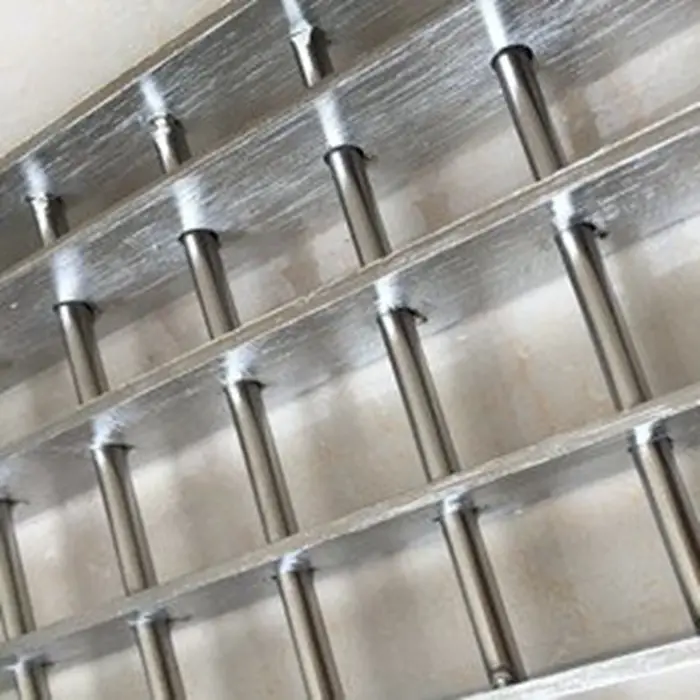
For large-scale flooring projects where maximum drainage and airflow are required, designers often move away from sheet-based plates toward bar-based systems. Achieving the correct serrated grating dimensions is a critical task for the structural engineer. Unlike a continuous plate, serrated bar grating consists of a series of vertical load-bearing bars with notched top edges, held together by cross-rods.
The "dimensions" in this context refer to the pitch (the distance between the bearing bars) and the depth of the bars themselves. For example, a common industrial specification might call for a 30mm pitch with 5mm thick bars. The depth of the notches or serrations is also standardized to ensure that they provide sufficient grip without compromising the load-bearing capacity of the steel. In a serrated grating dimensions calculation, the engineer must account for the "clear span"—the distance between structural supports. Stainless steel's high tensile strength allows for thinner bars compared to aluminum, which can reduce the overall weight of the flooring system while maintaining a higher safety factor. These dimensions are vital for ensuring the floor can support the weight of heavy forklifts or stationary machinery while remaining "transparent" to light and air.
Why Stainless Steel Anti-Skid Plate Outperforms the Competition
While there are many serrated gratings made from galvanized carbon steel or aluminum, stainless steel remains the premium choice for critical applications. Carbon steel gratings rely on a zinc coating for protection; however, in high-traffic areas, the serrations can wear through the galvanization, exposing the raw steel to rust. Aluminum, while lightweight, lacks the hardness of stainless steel, meaning its serrated teeth can become dull or "rounded" over time under heavy abrasive use.
The Serrated Stainless Steel Anti-Skid Plate utilizes alloys like Grade 304 or 316. These materials are naturally resistant to the corrosive "pitting" caused by chlorides and acids. In the food and beverage industry, where strict hygiene standards require frequent cleaning with caustic chemicals, stainless steel is the only material that can withstand the sanitation cycles without degrading. Furthermore, in "clean-room" or pharmaceutical environments, the non-porous surface of a stainless steel anti skid metal plate prevents the growth of bacteria and fungi, marrying physical safety with biological security.
Anti-Skid Plate: A Foundation of Absolute Stability
The integration of serrated gratings and anti-skid plates into modern architecture and industrial design is a testament to the prioritization of human life and operational efficiency. From the aggressive traction of a perforated anti skid plate to the structural precision required for a steel serrated anti slip stair tread, every element of these systems is designed to counteract the unpredictability of the environment.
By carefully calculating serrated grating dimensions and choosing high-grade stainless steel, facilities can move away from "reactive" safety measures—like adhesive tapes or temporary mats—toward a "proactive" structural solution. These plates and gratings do not just sit on the floor; they become an active part of the facility’s safety culture, providing a silent, unyielding grip that allows workers to focus on the task at hand, regardless of what has been spilled or what the weather brings.