
The modern security landscape requires a physical deterrent that is both intimidating and structurally unyielding. To meet this demand, specialized manufacturing facilities have evolved into high-tech hubs of metallurgical precision. At the heart of this industry is the razor barbed wire production workshop, a place where raw steel coils are transformed into formidable barriers. Unlike traditional fencing, the production of razor wire involves a complex synergy of high-speed punching, cold-crimping, and tension testing.
The Core Manufacturing Process: Crafting Razor Type Barbed Wire
The primary focus of a high-output production workshop is the creation of the razor type barbed wire, a product characterized by its sharp, tape-like blades and high-tensile core. The process begins with two distinct raw materials: a coil of high-carbon steel wire and a roll of galvanized or stainless steel tape. The manufacturing sequence is a testament to automated efficiency.
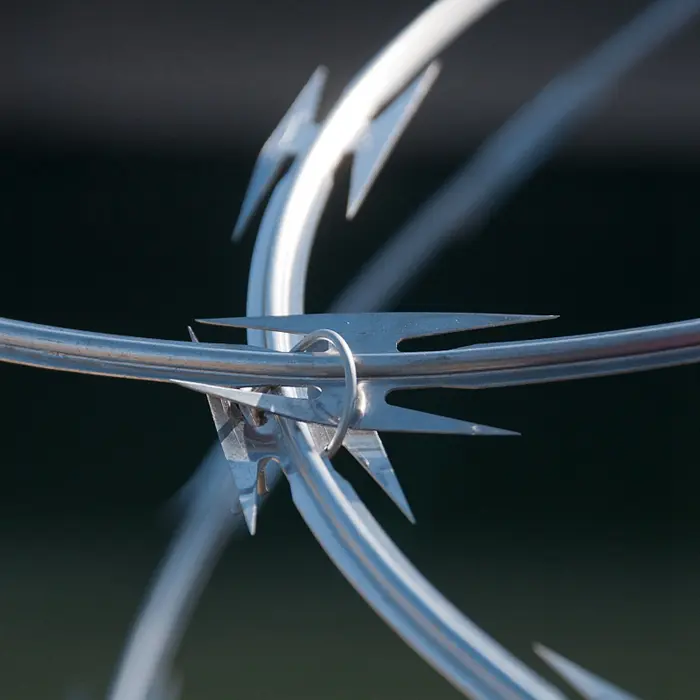
First, the steel tape is fed through a high-speed precision punching machine. This machine utilizes a heavy-duty die to cut the tape into the specific "razor" profile. Depending on the security requirement, the die can be changed to produce different blade lengths and shapes, such as the common BTO-22 or the more aggressive CBT-65 profile. The sharp edges are cut with extreme accuracy to ensure that the blades remain lethal over thousands of meters.
Once the razor tape is punched, it is moved to the "combining" or "crimping" station. Here, the high-tensile core wire is introduced. The razor type barbed wire is formed as the machine cold-crimps the razor tape tightly around the central wire. This is a critical step; if the tape is not securely fastened, it could be stripped off by an intruder, rendering the barrier ineffective. The result is a unified, rigid strand that combines the tensile strength of the core with the cutting power of the blades.
Comparing Barriers: Razor Wire Fence vs Barbed Wire in Production
In the workshop, technicians often produce different grades of materials based on the client’s security needs. One of the most frequent discussions among procurement officers involves the choice of razor wire fence vs barbed wire. While both serve as deterrents, their production methodologies and physical properties are vastly different.
Traditional barbed wire is produced by twisting two strands of wire together and intermittently wrapping "barbs" around them. This is a relatively simple mechanical process. However, the production of a razor wire fence requires more complex equipment and higher-grade materials. The workshop must maintain strict quality control over the "spring" of the wire. Razor wire is often designed to be installed in concertina coils, meaning the wire must have enough memory to return to its circular shape after being stretched.
From a security standpoint, the razor wire fence vs barbed wire debate is usually settled by the level of threat. Barbed wire is primarily an agricultural tool used to contain livestock, whereas razor wire is a psychological and physical weapon designed to stop human intrusion. In the workshop, razor wire is often fitted with stainless steel clips that join multiple loops together, creating a dense, three-dimensional mesh that is impossible to compress or crawl through—a feature that standard barbed wire simply cannot provide.
Strategic Sourcing and the Razor Barbed Wire Price
For wholesale buyers and government contractors, understanding the factors that influence the razor barbed wire price is essential for project budgeting. Inside the workshop, the cost of production is driven by several variables that go beyond the length of the wire.
Material Grade: The use of stainless steel (Grade 304 or 316) significantly increases the razor barbed wire price compared to galvanized carbon steel. However, stainless steel is essential for coastal or high-corrosion environments.
Zinc Coating Thickness: For galvanized products, the amount of zinc applied (measured in grams per square meter) is a major price driver. Hot-dipped galvanization with a thick coating provides a longer lifespan but comes at a premium.
Blade Density: The spacing between the razor blades affects the amount of steel tape used. "High-density" configurations provide more deterrence but require more raw material per meter.
Coil Diameter and Number of Clips: Larger concertina coils with more internal clips require more labor and material to assemble, which is reflected in the final razor barbed wire price.
Workshops that offer transparency in these specifications allow buyers to make informed decisions, balancing the immediate cost with the long-term durability and security requirements of the site.
Razor Barbed Wire: Safety and Quality Control in the Workshop
Operating a razor barbed wire production line is an inherently hazardous task that requires strict safety protocols. The workshop must be equipped with advanced ventilation systems to handle the fine metal dust generated during the punching process, and workers must wear specialized protective gear to prevent accidental lacerations.
Quality control is integrated into every stage. Automated sensors monitor the tension of the core wire to ensure it meets the specified breaking strength. If the wire is too brittle, it might snap under thermal expansion; if it is too soft, it can be easily cut with manual tools. Samples from every batch are subjected to "pull-tests" and salt-spray tests to simulate years of environmental exposure. This rigorous testing ensures that the razor type barbed wire leaving the facility is capable of standing as a silent, unyielding guardian for decades.
Razor Barbed Wire : Engineering Peace of Mind
The production of razor barbed wire is a sophisticated blend of heavy industry and precision engineering. From the high-speed punching of the blades to the careful calibration of the concertina clips, every step in the workshop is designed to create a barrier that is as resilient as it is intimidating. By understanding the differences between razor wire fence vs barbed wire and the factors that determine the razor barbed wire price, security professionals can select the most effective tools for their perimeter defense. As global security challenges continue to evolve, the razor wire workshop remains a vital part of the infrastructure that protects our borders, our assets, and our communities.