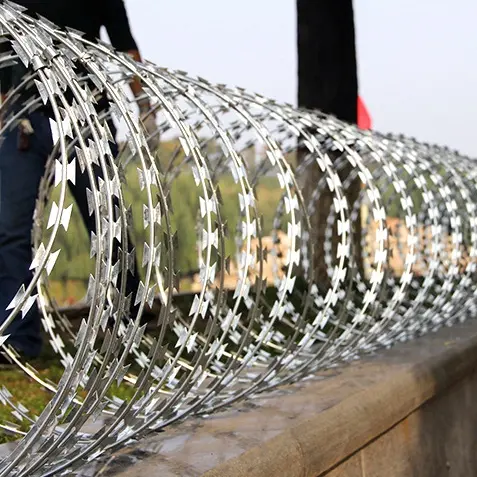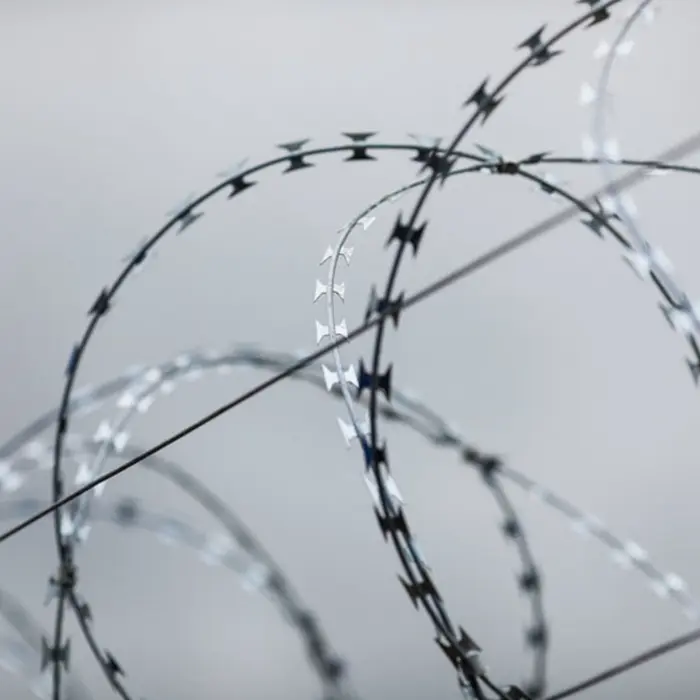

Razor barbed wire is widely used, mainly to prevent criminals from climbing or climbing over walls and fence climbing facilities, so as to protect property and personal safety.
Generally it can be used in various buildings, walls, fences and other places.
For example, it can be used for security protection in prisons, military bases, government agencies, factories, commercial buildings and other places. In addition, razor barbed wire can also be used for security protection in private residences, villas, gardens and other places to effectively prevent theft and intrusion.
In the realm of modern physical security, the requirement for a barrier that is both physically impassable and psychologically intimidating has led to the widespread adoption of specialized steel deterrents. Among these, the galvanized razor wire fence stands as a pinnacle of industrial design, offering a level of protection that traditional fencing cannot match. The effectiveness of these systems is not merely a result of their sharp blades, but rather a combination of advanced metallurgy and geometric configuration.
For security professionals and facility managers, the transition from standard barriers to a comprehensive concertina razor wire system represents a significant upgrade in defensive posture. Whether securing a national border, a hazardous industrial site, or a high-value storage facility, understanding the technical specifications and installation logic of these materials is essential for creating an airtight perimeter.
The Science of Longevity: Implementing a Galvanized Razor Wire Fence
The primary challenge for any outdoor security installation is environmental degradation. Steel, while strong, is naturally susceptible to oxidation. To address this, high-security projects utilize a hot-dipped galvanization process, which is fundamental to the construction of a galvanized razor wire fence. This process involves submerging the core wire and the razor tape into a bath of molten zinc at temperatures exceeding 450°C.
The resulting zinc-iron alloy layers provide a multi-stage defense against the elements. Even if the surface is scratched during a breach attempt, the surrounding zinc acts as a sacrificial anode, corroding in place of the underlying steel. This is particularly vital in coastal or industrial environments where salt spray or chemical pollutants would otherwise compromise the structural integrity of the wire within a few years.
A professional galvanized razor wire fence is typically built upon a foundation of high-tensile carbon steel. This ensures that the wire cannot be easily cut with standard bolt cutters, as the hardness of the metal requires specialized tools and significant time to penetrate. The combination of chemical resistance and mechanical strength makes this type of fencing the global standard for "hardened" perimeters, providing a service life that often exceeds thirty years with minimal maintenance.
Geometry and Entanglement: The Mechanics of Concertina Razor Wire
While the material properties provide durability, the spatial configuration of the barrier provides the actual deterrent. The most effective form of this material is known as concertina razor wire, named after the musical instrument due to its bellows-like expansion. Unlike straight-line wire, concertina coils are clipped together at multiple points around their circumference. When the coil is stretched out, it forms a dense, three-dimensional tube that is nearly impossible to navigate.
The clipping mechanism is the secret to its success. By using heavy-duty steel clips to join adjacent loops, the concertina razor wire prevents an intruder from simply spreading the wires apart to create a gap. If a single strand is cut, the tension in the rest of the coil causes it to spring back and potentially entangle the cutter, rather than falling away and leaving an opening.
This configuration is specifically designed to target the three main methods of fence breaching: climbing, cutting, and crawling.
Climbing: The overlapping blades and the unstable, "springy" nature of the coils mean that any weight applied to the wire causes it to move, making it impossible for a climber to find a stable handhold or foothold.
Cutting: The high-density of the blades in a concertina format means an intruder must make dozens of precision cuts to create a hole large enough for a human body, all while being at risk of serious injury from the surrounding tensioned blades.
Crawling: When deployed as a "ground obstacle," multiple rows of concertina coils can be stacked to create a wide zone of entanglement that prevents anyone from moving through the area, even with protective padding.
Strategic Procurement: Navigating Concertina Razor Wire for Sale
For large-scale infrastructure projects, the procurement process is as critical as the installation. When searching for concertina razor wire for sale, buyers must look beyond the price per roll and evaluate the technical data sheets that define the barrier's performance. There are several key variables that determine the effectiveness of a shipment.
First is the coil diameter. Standard diameters range from 450mm to 980mm. A larger diameter provides a more significant physical obstacle but requires more robust support structures. Second is the blade profile. "Long Blade" profiles (typically 60mm to 65mm) offer the highest level of entanglement and are standard for prison and military use, whereas "Medium Blade" profiles are often sufficient for commercial and industrial sites.
Furthermore, the number of clips per loop is a vital metric. A "5-clip" configuration creates a much denser and more rigid cylinder than a "3-clip" configuration. When evaluating concertina razor wire for sale, it is also important to verify the weight of the zinc coating. For long-term installations, a coating of at least 200g/m² is recommended to ensure the wire does not lose its sharpness to rust. High-quality suppliers will provide certificates of compliance to ensure the steel grade and galvanization levels meet international standards like ASTM or BS.
Galvanized Razor Wire Fence: Deployment Tactics and Safety Integration
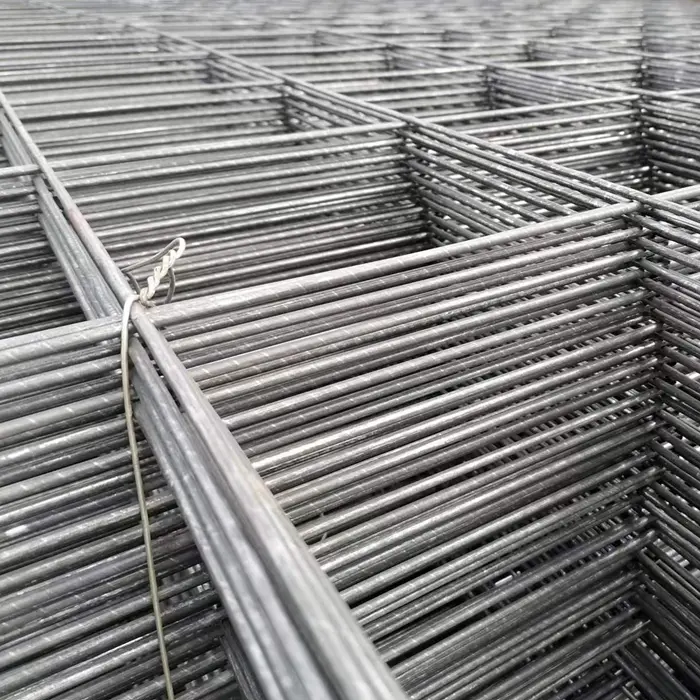
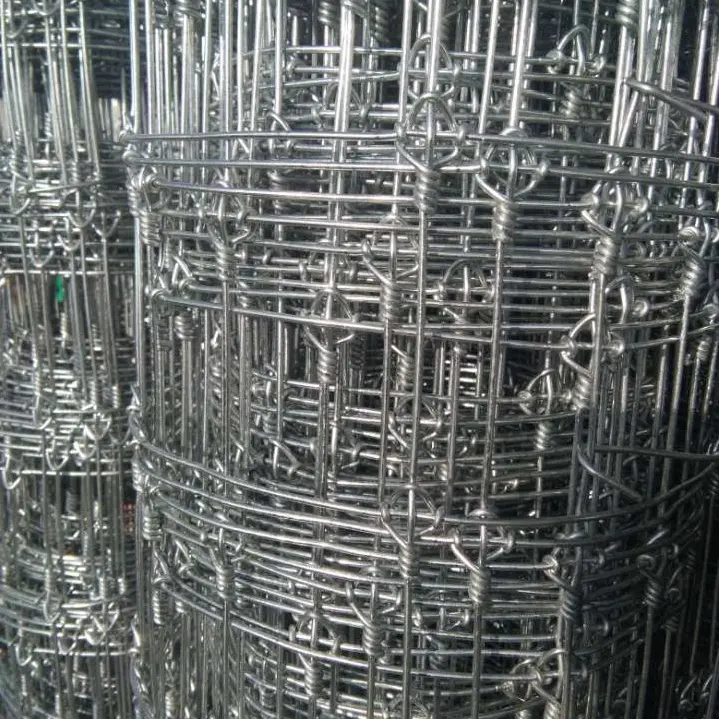
The final effectiveness of a galvanized razor wire fence depends heavily on how it is integrated into the existing site architecture. It is rarely used as a standalone solution; instead, it is most often mounted as a "top-level" deterrent. Using Y-shaped or L-shaped extension arms, the concertina razor wire is suspended above a standard chain-link or welded mesh fence. This forces any intruder to deal with two completely different types of obstacles: a vertical climb followed by a three-dimensional entanglement zone.
Safety and legal compliance are also paramount. Because of the lethal nature of razor wire, it must be installed at a height that prevents accidental contact by pedestrians or wildlife. Most jurisdictions require that the wire starts no lower than 2.1 meters (7 feet) from the ground. Warning signs must be placed at regular intervals to clearly communicate the danger, serving as the first layer of psychological deterrence before the physical barrier is even reached.
In high-threat environments, such as ammunition depots or sensitive research labs, a "pyramid" deployment is used. This involves placing two rows of concertina coils on the ground with a third row secured on top of them, held together by wire stays. This creates a wide, impenetrable belt that is visible from a distance and virtually impossible to breach without heavy machinery.