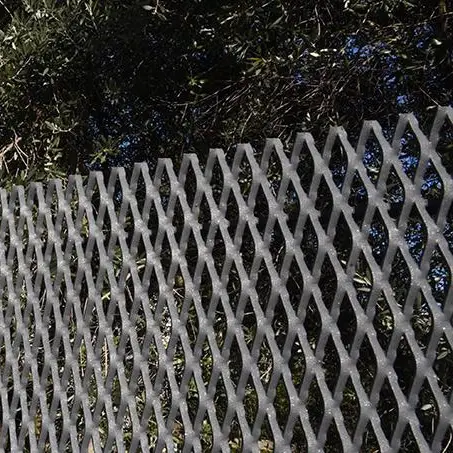

Expanded steel mesh is usually made of high-strength steel and can withstand large impacts and pressure, thereby effectively preventing objects from falling from high places and injuring people. At the same time, after undergoing surface anti-corrosion treatment, expanded steel mesh can have a long service life. Long life, not easily affected by the natural environment, and can be used in different climate and environmental conditions.
In addition, the expanded steel mesh also has good light transmittance and ventilation, which can reduce the accumulation of water and snow on the road and improve the safety of the road.
The choice of fencing for modern industrial, commercial, and high-security sites increasingly moves beyond traditional chain link or welded wire panels. The expanded metal fence design offers a superior combination of strength, visibility, and anti-climb features, making it the preferred solution for projects demanding both security and aesthetics. A Customized High-Quality Expanded Metal Mesh Fence system is engineered to meet site-specific requirements, delivering exceptional durability and tailored security performance.
Understanding Expanded Metal Fence Design and Manufacturing
Expanded metal mesh is manufactured from a single sheet of metal (steel, aluminum, or stainless steel) that is simultaneously slit and stretched. Unlike woven or welded products, this process creates a continuous, unitary pattern of diamond-shaped openings without any interlocks or welds that could fail under stress. This monolithic structure is the foundation of the material's inherent strength.
Rigidity and Impact Resistance: The non-welded joints mean that stress is distributed uniformly across the mesh panel. This significantly enhances the panel's rigidity, making it highly resistant to impact and deformation compared to a simple wire mesh.
Anti-Climb Features: A critical aspect of a security fence is its anti-climb capability. The diamond-shaped openings in expanded metal fence design are typically too small and oddly angled to offer easy toeholds or handholds, effectively deterring unauthorized scaling. Furthermore, the sharp, continuous edges inherent to the expanded process can act as a psychological and physical deterrent against climbing or forced entry.
Visibility: Despite its structural strength, the open mesh design maintains high visibility, which is essential for surveillance systems and security personnel. The unique angle of the strands can even provide better visibility when viewed from an angle perpendicular to the fence line while obscuring the view from an oblique angle (anti-glare), a feature useful in roadside or controlled access areas.
Durability Through Galvanised Expanded Mesh
For any exterior fencing application, corrosion resistance is paramount to ensure a long service life and minimal maintenance costs. The use of galvanised expanded mesh is the industry standard for achieving this durability.
Hot-Dip Galvanization: This process involves immersing the fabricated steel mesh panels into a bath of molten zinc. The resulting zinc coating metallurgically bonds to the steel, creating a tough, protective barrier that shields the underlying steel from the environment.
Superior Edge Protection: Unlike welded products, where the weld points can burn off or thin the protective coating, the unitary nature of expanded metal means the galvanization process covers all surfaces, including the cut edges of the diamonds, providing comprehensive, seamless protection.
Optional Powder Coating: For high-quality, customized projects, the galvanised expanded mesh is often finished with a secondary layer of architectural-grade polyester powder coating. This duplex system (galvanizing plus powder coating) offers maximum resistance to weathering, UV degradation, and abrasion. The powder coating can be specified in various RAL colors to match branding or surrounding architecture, enhancing the aesthetic appeal of the expanded metal security fence.
The Engineered Solution: The Expanded Metal Security Fence
The term expanded metal security fence signifies a system designed and manufactured specifically to meet elevated security standards, often deployed in military bases, utility substations, data centers, and critical infrastructure projects.
Custom Mesh Specifications: High-security applications require customized mesh sizes and thicknesses. The mesh opening size (Short Way of the Diamond, SWD, and Long Way of the Diamond, LWD) and the strand thickness are calibrated to specific threat levels, often demanding sizes that make cutting with standard tools exceptionally difficult.
Frame and Post Integration: The effectiveness of the mesh depends entirely on the frame and post system.
High-Quality Frames: Panels are typically secured within a heavy tubular or angle iron frame to maintain rigidity. This frame is then securely fastened to the posts using tamper-proof hardware (e.g., shear nuts or unique bolt systems).
Post Design: Posts are often steel H-beams or heavy square tubing, buried deep in concrete footings to resist vehicle impact or forced pushing. The connection between the panel frame and the post is engineered to eliminate any weak points.
Integration with Electronic Security: The monolithic construction of the expanded metal panel makes it an ideal substrate for integrating electronic security systems. Vibration sensors, tension monitoring wires, and fiber-optic intrusion detection cables can be easily mounted directly to the panel without compromising signal integrity, turning the physical barrier into a monitored electronic defense line.
A Customized High-Quality Expanded Metal Mesh Fence offers a highly reliable, durable, and visually appealing solution for modern perimeter security. By leveraging a robust expanded metal fence design that maximizes rigidity and anti-climb properties, utilizing high-performance galvanised expanded mesh with optional powder coating for ultimate corrosion protection, and engineering the system specifically as an expanded metal security fence, facility owners can achieve a superior level of defense against intrusion and vandalism. This engineered approach ensures the fence is not just a boundary but an active, long-lasting component of the overall security strategy.